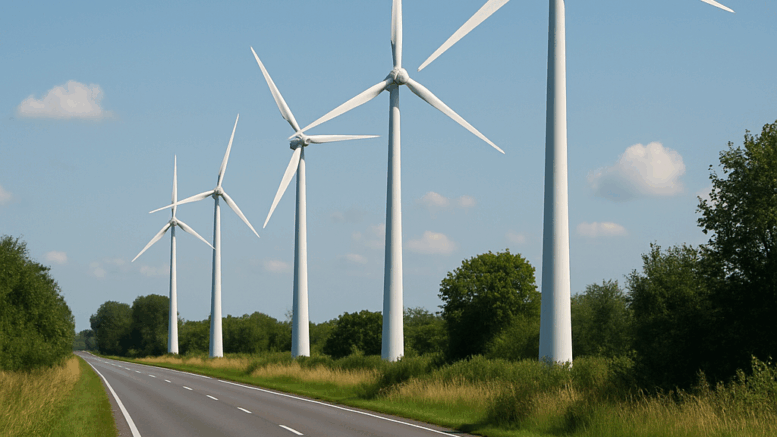
In 2025, wind power technology has reached unprecedented heights—literally—as the industry pushes toward taller turbines to harness stronger, steadier winds at altitude.
The most striking developments include China’s deployment of a 340-meter-tall offshore turbine by Dongfang Electric, capable of generating 26 MW with 150-meter blades that rival the wingspan of the largest aircraft.
Meanwhile, Germany has introduced the tallest land-based wind turbine to date, standing at 363 meters and using an innovative lattice tower design from Gicon-Beventum that allows internal lifting of the nacelle during installation and maintenance.
This structure not only overcomes the logistical challenges of supertall cranes but also enables up to 40% more energy production from the same rotor diameter simply by elevating it into stronger wind currents. Across the globe, countries are scaling up turbine size as a strategy to increase capacity factors and reduce the number of turbines needed per site.
Offshore towers are now approaching 500 feet and expected to rise further as next-generation machines approach 21 MW per unit. To support this growth, test facilities in Denmark (Østerild) and the UK (Blyth) are expanding to accommodate towers up to 400 meters and blades as long as 180 meters, tackling challenges like tip-speed erosion and structural fatigue at extreme scales.
Advances in carbon-fiber composites, modular tower sections, and AI-optimized load design are helping engineers manage the enormous stresses and logistics of these mega-structures.
The drive for height is far from cosmetic: a mere 17-meter increase in hub height can unlock enough wind shear to justify longer blades, vastly improving a turbine’s energy output. Looking forward, the arms race in turbine height continues, with taller designs enabling repowering of ageing wind farms (notably in India) and opening previously unviable low-wind sites to clean energy development.